Rome Travel Guide: One‑Day Itinerary, Major Attractions & Insider Tips
Rome is one of the most beautiful cities in Italy — a place where history stretches back to 753 B.C. and still lives in every street. The city is overflowing with archaeological sites, iconic attractions, and unforgettable experiences. With everything Rome has to offer, you could spend a lifetime exploring it. No wonder they call it The Eternal City.
Attracting millions of visitors every year, Rome is also a perfect place to begin any Italian adventure. I had the luxury of flying in for a weekend and managed to see far more than I expected. I arrived on Friday morning, enjoyed a full Saturday in the city, and left on Sunday. Even with just one full day, you’d be surprised by how much you can experience.
Going to Rome from Fiumicino
I arrived at Fiumicino International Airport (IATA: FCO) on a Friday morning. After collecting my luggage, I recommend skipping the taxi — fares can be high, and traffic into Rome is unpredictable. Instead, follow the signs inside the terminal to the airport train station.
From there, take the Leonardo Express to Roma Termini, the city’s main train hub and the easiest gateway into central Rome. If you’re unsure which platform or train to take, just stop by the airport information desk and ask for the train to Rome Termini. Tickets cost €14 per adult, and the ride takes 30–45 minutes, depending on the departure.
I booked an Airbnb just a short walk from Termini, which made it incredibly convenient to drop off my bags and start exploring right away.
Basilica Papale di Santa Maria Maggiore
Though my full day in Rome hadn’t officially begun, I decided to explore a nearby landmark before checking in. I walked over to Piazza di Santa Maria Maggiore, home to one of Rome’s most important basilicas. According to tradition, Pope Liberius saw the Virgin Mary in a dream, inspiring the creation of a church on this very site. Later, in 432 A.D., Pope Sixtus III ordered the construction of the basilica we see today.
Santa Maria Maggiore is also tied to the famous Miracle of the Snow — a legend in which a blanket of snow appeared on this hill in the middle of August. Every year on 5 August, the event is commemorated inside the basilica with white flower petals gently falling from the ceiling, recreating the miracle.

Just across the street, you’ll find Bar Molino, a cozy bakery and kitchen that’s perfect for a quick stop. Grab a glass of wine and a few slices of their fresh pizza. If it’s your first time in Italy, you’ll quickly learn that pizza changes from region to region — and this spot will definitely leave you wanting more.

After eating some food and drinking a few glasses of wine, it was time to to actually head towards the AirBnB and check in. I stayed at Hotel Des Artistes, perfectly located near the main train station and the metro stop Castro Pretorio.
Colosseum
Depending on how you feel after arriving, you can head straight to the Colosseum that same evening. Seeing it at night is a completely different experience — the warm lights glowing through the arches make the entire structure feel alive. The most iconic monument of the Roman Empire becomes even more dramatic after sunset, and witnessing it in that quiet nighttime atmosphere is something you shouldn’t miss.

As you stand before nearly 2,000 years of history, it’s impossible not to imagine the era of “Bread and Circuses.” This was the Roman Empire’s way of keeping the public entertained with grand spectacles inside the Flavian Amphitheatre: exotic animals, executions, naval battle reenactments, and gladiator fights that thrilled more than 50,000 spectators. It truly is one of the wonders of the world.
I recommend returning the next morning as well. I did the same — seeing the Colosseum in daylight gives you a completely different perspective, and both moments together make the experience unforgettable.
Big Bus Rome Hop-on Hop-off Tour
It was Saturday — my full day in Rome — and I started the morning with a quick breakfast near my stay. Afterwards, I took the metro to Roma Termini. Once you arrive, walk up to the ground level and head toward the front of the station. This is where you’ll find the hop‑on hop‑off buses.

I bought a 24‑hour pass with Big Bus Tours, one of the easiest ways to cover a lot of ground in a short time. You can’t miss their bright red buses, though several other sightseeing companies operate from the same area, so choose whichever fits your schedule best.
The panoramic tour offers a great overview of Rome, with informative commentary that helps you understand the city’s culturally rich past while you ride between major landmarks.
Altare della Patria
If you’re riding with Big Bus Tours, this stop is near Stop 5. Here, in Piazza Venezia, you’ll find the colossal white monument dedicated to Vittorio Emanuele II, also known as the Altare della Patria (Altar of the Fatherland). Built between 1895 and 1911 and designed by Giuseppe Sacconi, the monument rises above the city with striking white marble sourced from the region of Brescia.

Because of its massive size — 135 meters wide and 70 meters high — Romans have given it several playful nicknames over the years, including the wedding cake, the dentures, and the typewriter. Despite the humor, the monument holds deep national significance.
In front of the structure stands a monumental bronze equestrian statue of Victor Emmanuel II, the first king of a united Italy. He was the first to hold that title since the 6th century, making this site a powerful symbol of Italian unification.
Roman Forum
Right next to the Altar of the Fatherland, on the right side as you face the monument, follow the steps that lead up to the Cordonata Capitolina. This grand staircase was designed by Michelangelo and guides you into Piazza del Campidoglio, the square that houses the Comune di Roma, Rome’s City Hall. Take a moment to admire the harmonious architecture around you — Michelangelo’s design blends Renaissance elegance with the ancient foundations beneath it.

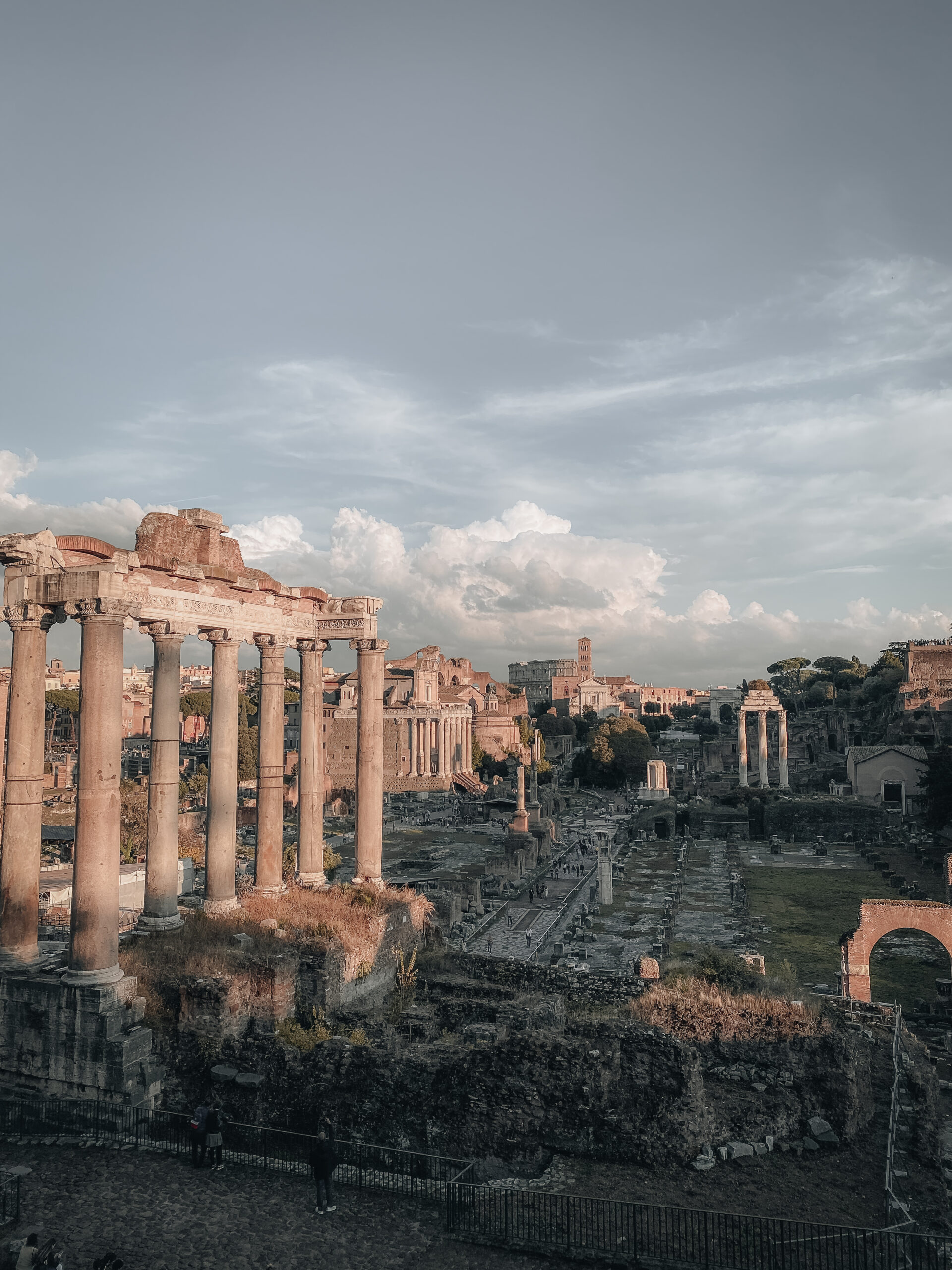
From here, walk toward the right side of the square. A small alleyway will lead you to the Roman Forum Panoramic Viewpoint, one of the most spectacular overlooks in the city. As you step out onto the terrace, Ancient Rome unfolds beneath you.
The Roman Forum — Forum Romanum in Latin — was the beating heart of the ancient city. This was the center of religious ceremonies, political debates, public speeches, markets, and social life. Historians believe people first began gathering here around 500 B.C., at the dawn of the Roman Republic. From this vantage point, you can see temples, arches, and ruins that once shaped the world, all framed by the distant silhouette of the Colosseum.
The Spanish Steps and Piazza Del Popolo
After leaving the viewpoint, I made my way back to the Big Bus stop and rode it all the way to Stop 7. This stop places you within easy walking distance of Piazza del Popolo and the iconic Spanish Steps. These beautifully designed Baroque‑style steps are one of those must‑see landmarks when visiting Rome. It’s the perfect place to sit, relax, and soak in the atmosphere and sweeping views of the Eternal City.

The staircase consists of 138 irregular steps that connect the lower Piazza di Spagna with the upper Piazza Trinità dei Monti, crowned by the twin‑tower church that dominates the skyline. The Spanish Steps’ unique design and elegance have long attracted artists, painters, poets, and photographers. Their presence once drew many beautiful women hoping to be chosen as models. Today, you’ll find crowds gathered for a different reason — everyone trying to capture that perfect Instagram photo.
At the base of the stairs sits the Fontana della Barcaccia, or “Fountain of the Old Boat,” an early Baroque masterpiece. Shaped like a sinking ship, the fountain is inspired by a local legend: during a massive flood of the Tiber River in the 16th century, a fishing boat was carried all the way to this very spot. The fountain commemorates that unusual event and adds to the charm of the square.
Fontana di Trevi
From here, I wandered my way toward one of the most iconic fountains in Rome — and arguably the world — the Fontana di Trevi. This Baroque masterpiece, located in Piazza di Trevi, was constructed between 1732 and 1762. Although the original design was created for Pope Clement XII by the artist Bernini, construction didn’t begin until decades later, after a more affordable redesign by architect Nicola Salvi. Today, the fountain attracts millions of visitors each year and has appeared in famous films such as La Dolce Vita, Angels & Demons, The Lizzie McGuire Movie, and Roman Holiday.
The fountain rises nearly 30 meters high, built directly against the back of the Palazzo Poli. At its center, beneath the grand arch, stands Neptune, god of the sea, riding a shell‑shaped chariot pulled by two winged horses and guided by tritons. Look closely at the horses: one is calm and obedient, while the other is wild and restless — a symbolic representation of the ever‑changing moods of the sea. Flanking Neptune are two statues sculpted by Filippo della Valle: Abundance on the left and Health on the right.

The name Fontana di Trevi comes from tre via, meaning “three roads,” as three streets once converged at the site of the fountain. And of course, no visit is complete without participating in the famous tradition. Stand with your back to the fountain, close your eyes, and toss a coin over your left shoulder using your right hand. According to legend, one coin ensures your return to Rome, two coins promise romance, and three coins bring marriage — or divorce, depending on what you’re hoping for.
Every week, the municipality of Rome cleans the fountain and collects the coins. A large portion of the proceeds — estimated at around €1.4 million annually — is donated to charities that support families in need. It’s a beautiful reminder that even small wishes can make a meaningful difference.
Castel Sant Angelo
With daylight running out, I made my way toward Castel Sant’Angelo, which corresponds to Big Bus Stop 6. This imposing structure was originally built in the 2nd century as a mausoleum for Emperor Hadrian and his family. It wasn’t associated with its current name until 590 A.D., when Pope Gregory I claimed to have seen the Archangel Michael atop the mausoleum, sheathing his sword as a sign that the plague had come to an end. In 1753, Pope Pius II commemorated this vision by building a chapel at the exact spot where the archangel was said to appear.
Castel Sant’Angelo has also made its way into modern culture — most notably in Angels & Demons, where it’s depicted as a hideout for the Illuminati. Whether or not you’ve seen the film, the fortress itself feels cinematic, especially as the sun begins to set over Rome.

The castle is connected to the opposite side of the Tiber River by the elegant Ponte Sant’Angelo, or Bridge of the Holy Angel. Each side of the bridge is lined with five angel statues, sculpted by pupils of the great Bernini. Each angel carries an object symbolizing the Passion of Christ, turning the bridge into a serene open‑air gallery that leads you straight toward the castle’s entrance.
Vatican City
Near Castel Sant’Angelo lies Vatican City, a sovereign city‑state entirely surrounded by Rome and the spiritual headquarters of the Roman Catholic Church. It is the home of the Pope and a treasure trove of iconic art, architecture, and religious history.
The Vatican Museums house some of the most important works of the ancient and Renaissance worlds, including masterpieces like Laocoön and His Sons, the frescoes of the Raphael Rooms, and of course the Sistine Chapel, world‑famous for Michelangelo’s breathtaking ceiling. Few places on earth contain such a concentrated collection of human creativity and cultural heritage.

One of the most sacred sites in Christendom, Vatican City stands as a testament to more than two millennia of history. At its heart rises St. Peter’s Basilica, built over the tomb of the Apostle Peter — the first in the uninterrupted succession of Roman pontiffs. As a major pilgrimage destination, the Vatican remains directly and tangibly linked to the story of Christianity.
Beyond its spiritual significance, Vatican City is also an extraordinary example of Renaissance and Baroque art. Every corner, from its courtyards to its chapels, reflects the vision of the great masters who shaped its identity.
Final Thoughts
It was Sunday, and time for me to catch my flight back to Catania. Rome is one of those cities that offers so much that you could live there for an eternity and still find yourself falling in love with it over and over again. A short weekend was enough to see some of the highlights, but I truly recommend staying longer. With more time, you can walk inside the Colosseum, wander through the Roman Forum, and admire the incredible collection of art inside the Vatican Museums.
I tossed one coin into the Fontana di Trevi — so I guess that means I’ll be coming back. And honestly, after experiencing even a glimpse of what Rome has to offer, I know I will.

What other cities in Italy would you like to visit? Leave comments and questions below and I will respond as soon as possible.